What Do Templar Symbols Mean?
The Knights Templar used a number of symbols that have become famous in modern culture. The most famous is the red cross on a white background, which was the symbol of the Order. Other symbols include the Beauséant, the war banner of the Order, and the seal of the Order. The meaning of these symbols has been the subject of much debate, both in the medieval period and in the modern world. The most authoritative modern discussion of the Order’s symbols and what they meant to the Templars themselves is Malcolm Barber’s The New Knighthood (1994); the modern mythology is treated in the same author’s The Templars (2012) and in the older popular work by Stephen Howarth.
For the broader context, see the main article on the Knights Templar, the Templar rule and organization article, and who destroyed the Knights Templar.
The Red Cross
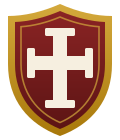
The most famous symbol of the Knights Templar is the red cross on a white background, which was worn on the habits and mantles of the Order. The red cross was adopted by the Order in 1147, when Pope Eugene III granted the Templars the right to wear the red cross. The cross was a symbol of the Order’s willingness to shed blood for the defense of the Christian faith.
The red cross was a powerful symbol. It identified the Templars on the battlefield, and it reminded them of their religious vocation. The red cross was also a sign of martyrdom: the Templars were expected to die, if necessary, in the defense of the Holy Land. The red cross was, in this sense, a powerful symbol of the Order’s commitment to its religious and military vocation.
The red cross was not unique to the Templars. The Knights Hospitaller wore a white cross on a black background, and the Teutonic Knights wore a black cross on a white background. The different crosses allowed the various military religious orders to be distinguished on the battlefield.
The red cross has been the subject of various myths in modern culture. Some modern writers have claimed that the red cross was adopted from a Muslim symbol, or that it was a sign of secret rituals. These claims are not supported by historical evidence, and they are part of the modern mythology that has grown up around the Templars.
The Beauséant
The Beauséant was the war banner of the Knights Templar. The banner was square or rectangular, and it was divided horizontally into two halves: the upper half was black, and the lower half was white. The banner was a powerful symbol of the Order, and it was used in battle to rally the Templars and to signal the beginning of an attack.
The Beauséant was a symbol of the Order’s discipline and its dual nature. The black and white halves of the banner were a sign of the Order’s commitment to the dual life of monasticism and warfare. The banner was also a sign of the Order’s willingness to fight to the death: the banner was not captured in battle, and the Templars were expected to defend it to the last.
The Beauséant has been the subject of various legends in medieval and modern culture. The most famous is the legend that the Beauséant was held in the Templar house in Jerusalem, and that the Templars would rally around it in times of crisis. The legend is not supported by historical evidence, but it has been a powerful image in Western culture.
The Seal of the Order
The seal of the Knights Templar was a powerful symbol of the Order’s authority. The seal was used on official documents, and it represented the authority of the Grand Master. The most common depiction of the seal shows the agnus Dei — the Lamb of God — bearing the cross of the resurrection, framed within a round shield. In medieval eyes the design could appear to show two figures, and an older tradition misread it as “two knights riding a single horse.” That tradition is rejected by modern historians, but it remains the source of a common myth that the early Templars were so poor they shared a horse. The Order was certainly poor in its first years, but the seal never actually depicted that.
Modern historians read the seal of the Order as a Christian devotional emblem, not as a depiction of poverty. The seal’s message is theological: the Order placed its military service under the sign of the sacrificial Lamb. The “two knights on one horse” reading is a piece of romantic medievalism, repeated for centuries and only corrected by modern sigillography.
The seal of the Order has been the subject of various legends. The most famous is the legend that the seal also contained the image of a skull, or that it contained a secret inscription. These legends are not supported by historical evidence, but they have been a part of the modern mythology that has grown up around the Templars.
The Image of the Templar Knight
The image of the Templar knight, with the white mantle and the red cross, has become one of the most famous images of the medieval world. The image has been used in countless works of art, literature, and film, and it has been a powerful symbol of Christian knighthood. The image of the Templar knight has also been used in modern popular culture, where it is often associated with the myths and legends that have grown up around the Order.
The image of the Templar knight was not always the same. In the early days of the Order, the Templars wore a simple habit, without the red cross. The red cross was added in 1147, and it became a permanent feature of the Templar habit. The white mantle was also a feature of the Order, and it was a sign of the Templars’ commitment to chastity and purity.
The image of the Templar knight has been the subject of various interpretations in modern culture. Some modern writers have emphasized the military aspect of the image, and they have portrayed the Templars as holy warriors. Others have emphasized the religious aspect of the image, and they have portrayed the Templars as monks who fought. The truth is probably a mixture: the Templars were both holy warriors and monks, and the image of the Templar knight captures both aspects of their vocation.
The Mythology of the Templar Symbols
The symbols of the Knights Templar have been the subject of intense mythology in the modern world. The most famous of the modern myths is the claim that the Templars had discovered the Holy Grail, or that they had guarded a great secret, perhaps the secret of the Holy Blood. These claims are not supported by historical evidence, and they are part of the modern mythology that has grown up around the Order.
The modern mythology of the Templar symbols has been promoted by various writers, including the French writer Maurice Magre and the German writer Otto Rahn, both of whom wrote about the Templars in the early 20th century. The mythology has also been promoted by the novelist Umberto Eco, in his novel Foucault’s Pendulum (1988), and by the American author Dan Brown, in his novel The Da Vinci Code (2003).
The modern mythology of the Templar symbols has been criticized by historians, but it has been remarkably durable. The mythology has been the subject of numerous books, films, and television shows, and it has been a powerful part of Western popular culture. The symbols of the Templars, especially the red cross and the Beauséant, have become powerful images of the medieval world, and they continue to fascinate modern audiences.
The Historical Meaning of the Symbols
The historical meaning of the Templar symbols is more straightforward than the modern mythology suggests. The red cross was a sign of the Order’s religious vocation, and it was adopted from the Christian tradition. The Beauséant was a war banner, and it was used in battle to rally the Templars. The seal of the Order was a sign of the Grand Master’s authority, and it was used on official documents.
The historical meaning of the Templar symbols is significant for understanding the Order. The symbols were not secret, and they were not the basis for any kind of mystery cult. The symbols were ordinary Christian symbols, and they were used to identify the Order and to remind the Templars of their religious vocation. The symbols of the Templars, in this sense, were an important part of the Order’s public identity.
The historical meaning of the symbols is also significant for understanding the trial of the Templars. The charges against the Templars included the accusation that they had worshipped a mysterious idol called Baphomet. The accusation was not based on solid evidence, and the historical meaning of the Templar symbols does not support the charge. The symbols of the Templars were Christian symbols, and the Order’s religious vocation was based on the traditional Christian faith.